Heber C. Kimball related a special Christmas experience as related in The Life of Heber C, Kimball by Orson F. Whitney (pages 173-174):
On Christmas a special conference was held in Preston by the Apostles. About three hundred of the Saints assembled, delegates being present from the various branches in and around Preston, extending some thirty miles. ...
"The Spirit of the Lord was with us; and truly the hearts of the Elders were rejoiced beyond measure when we contemplated the glorious work which had been done, and we had to exclaim, 'Blessed be the name of the Lord, who has crowned our labors with such success!' During the conference we confirmed fourteen members and blesssed about one hundred children."
... A beautiful and fitting celebration of that blessed day of days, when 'unto us a Child was born' to take away the sins of the world; when God descended from His throne and took upon Him flesh, exchanging crown for cross, and sceptred rule for martyrdom, in the cause of man's redemption. Shine out, ye blazing stars, and sun and moon give forth your warmth and lustre! Ye cannot dim the glory, nor vie the matchless love, of Him who set you there to light and cheer, on, onward to celestial heights the world He died to save!
I hope all of my friends and loved ones are filled with the same kind of joy described so beautifully by Orson F. Whitney in capturing the special experiences of the early missionaries in England.
Thursday, December 25, 2014

Saturday, December 13, 2014
Following in the steps of Heber C. Kimball
One of the joys we looked forward to in coming to Preston, England for our LDS Church service mission was the chance to be in the area where Lynn's great-great-great grandfather, Heber C. Kimball, opened up the first overseas mission for the Mormon Church in 1837.
Today, we took our first trip to places associated with his mission: Downham and Chatburn. My colleague in the Chorley, England area legal counsel office, Jay Peck, and his wife Joan were kind enough to offer to take us to one of their favorite places. The morning was a crisp, clear day so it was a perfect Saturday for this short day trip.
We had remembered reading about these towns as places where Heber C. Kimball had amazing experiences in his first months in England in the wonderful book on the Life of Heber C. Kimball, written by his grandson, Orson F. Whitney, who was also descended from Heber's first wife, Vilate Murray Kimball, like Lynn is. I will weave in some of his own words in describing our experiences there today.
The weather has been wet, breezy and cold the last few days, but the skies cleared overnight leaving the first touches of snow on the hillsides we could see out to the West and the North as we drove first to Preston and then up the Ribble River valley to these two small towns.
First, Jay took us to see the location in Chatburn where Heber's early baptisms took place in these two towns. It was a beautiful, quiet stream with a wider spot. Above it was a foot path leading to an old wagon road that climbs the hill toward Downham, one mile away. North of Downham is Pendle Hill which had a light dusting of snow this morning and an increased amount from the rain/hail that came through while we had a delightful English pub lunch at the Assheton Arms, in the middle of Downham. The whole town is much like it would have been in 1837 with old stone houses, stone walls along the narrow ways and footpaths heading into the hills. We chuckled to note that many of the guests in the restaurant had dogs with them as they had obviously been out on short hikes. Across the street was the town cathedral, St. Leonard's, which dates back to the early 1200's and was rebuilt in 1801 and renovated again in 1910. We heard that the Queen Mother once said in leaving the entrance to the small church that the view was one of the finest in England as it looked out across the church cemetery lot, across the small town below and up to the Pendle Hill outside the town.
Heber's experiences here were extraordinary. He mentions on page 169 of the book on his life:
"Having metioned my intention of going to Downham and Chatburn, to several of the brethren, they endeavored to dissuade me from going, informing me there could be no prospect of success whatever, as several ministers of different denominations had endeavored in vain to raise churches in these places, and had frequently preached to them, but to no effect, as they had resisted all the efforts and withstood the attempts of all sects and parties for the last thirty years, who, seeing all their attempts fail, had given them up to hardness of heart. ... However, this did not discourage me, believing that the Gospel of Jesus Christ could reach the heart, when the gospels of men proved abortive; I consequently told those brethren that there were the places I wanted to go to, for that it was my business not to call the righteous but sinners to repentance. ...
"In Chatburn I was cordially received by the inhabitants, who turned out in great numbers to hear me preach. They produced a large tithing barn, placing a barrel in the center, upon which I stood. I preached to them the first principles of the Gospel, spoke in simplicity upon the principles revealed by our Lord and Savior Jesus Christ, the conditions of pardon for a fallen world and the blessings and privileges of those who embraced the truth; I likewise said a little on the subject of the resurrection. My testimony was accompanied by the Spirit of the Lord, and was received with joy, and these people who had been represented as being hard and obdurate, were melted into tenderness and love. ... When I concluded I felt someone pulling at my coat, exclaiming, 'Maister, Maister.' I turned round and asked what was wanted. Mrs. Elizabeth Partington said, 'Please sir, will you baptize me?' 'And me?' 'And me?' exclaimed more than a dozen voices. Accordingly I went down into the water and baptized twenty-five. I was engaged in this duty, and confirming them and conversing with the people until after midniht.
"The next morning I returned to Downham, and baptized between twenty-five and thirty in the course of the day....These villages seemed to be affected from one end to the other; parents called their children together, spoke to them on the subjects which I had preached about, and warned them against swearing and all other evil practices, and instructed them in their duty.
"We were absent from Preston five days, during which time Brother Fielding and I baptized and confirmed about 110 persons; organized branches in Downham, Chatburn, Waddington and Clithero; ...This was the first time the people in those villages ever heard our voices, or saw an American."
(To be continued.)
Today, we took our first trip to places associated with his mission: Downham and Chatburn. My colleague in the Chorley, England area legal counsel office, Jay Peck, and his wife Joan were kind enough to offer to take us to one of their favorite places. The morning was a crisp, clear day so it was a perfect Saturday for this short day trip.
We had remembered reading about these towns as places where Heber C. Kimball had amazing experiences in his first months in England in the wonderful book on the Life of Heber C. Kimball, written by his grandson, Orson F. Whitney, who was also descended from Heber's first wife, Vilate Murray Kimball, like Lynn is. I will weave in some of his own words in describing our experiences there today.
The weather has been wet, breezy and cold the last few days, but the skies cleared overnight leaving the first touches of snow on the hillsides we could see out to the West and the North as we drove first to Preston and then up the Ribble River valley to these two small towns.
First, Jay took us to see the location in Chatburn where Heber's early baptisms took place in these two towns. It was a beautiful, quiet stream with a wider spot. Above it was a foot path leading to an old wagon road that climbs the hill toward Downham, one mile away. North of Downham is Pendle Hill which had a light dusting of snow this morning and an increased amount from the rain/hail that came through while we had a delightful English pub lunch at the Assheton Arms, in the middle of Downham. The whole town is much like it would have been in 1837 with old stone houses, stone walls along the narrow ways and footpaths heading into the hills. We chuckled to note that many of the guests in the restaurant had dogs with them as they had obviously been out on short hikes. Across the street was the town cathedral, St. Leonard's, which dates back to the early 1200's and was rebuilt in 1801 and renovated again in 1910. We heard that the Queen Mother once said in leaving the entrance to the small church that the view was one of the finest in England as it looked out across the church cemetery lot, across the small town below and up to the Pendle Hill outside the town.
Heber's experiences here were extraordinary. He mentions on page 169 of the book on his life:
"Having metioned my intention of going to Downham and Chatburn, to several of the brethren, they endeavored to dissuade me from going, informing me there could be no prospect of success whatever, as several ministers of different denominations had endeavored in vain to raise churches in these places, and had frequently preached to them, but to no effect, as they had resisted all the efforts and withstood the attempts of all sects and parties for the last thirty years, who, seeing all their attempts fail, had given them up to hardness of heart. ... However, this did not discourage me, believing that the Gospel of Jesus Christ could reach the heart, when the gospels of men proved abortive; I consequently told those brethren that there were the places I wanted to go to, for that it was my business not to call the righteous but sinners to repentance. ...
"In Chatburn I was cordially received by the inhabitants, who turned out in great numbers to hear me preach. They produced a large tithing barn, placing a barrel in the center, upon which I stood. I preached to them the first principles of the Gospel, spoke in simplicity upon the principles revealed by our Lord and Savior Jesus Christ, the conditions of pardon for a fallen world and the blessings and privileges of those who embraced the truth; I likewise said a little on the subject of the resurrection. My testimony was accompanied by the Spirit of the Lord, and was received with joy, and these people who had been represented as being hard and obdurate, were melted into tenderness and love. ... When I concluded I felt someone pulling at my coat, exclaiming, 'Maister, Maister.' I turned round and asked what was wanted. Mrs. Elizabeth Partington said, 'Please sir, will you baptize me?' 'And me?' 'And me?' exclaimed more than a dozen voices. Accordingly I went down into the water and baptized twenty-five. I was engaged in this duty, and confirming them and conversing with the people until after midniht.
"The next morning I returned to Downham, and baptized between twenty-five and thirty in the course of the day....These villages seemed to be affected from one end to the other; parents called their children together, spoke to them on the subjects which I had preached about, and warned them against swearing and all other evil practices, and instructed them in their duty.
"We were absent from Preston five days, during which time Brother Fielding and I baptized and confirmed about 110 persons; organized branches in Downham, Chatburn, Waddington and Clithero; ...This was the first time the people in those villages ever heard our voices, or saw an American."
(To be continued.)
Friday, September 19, 2014
Gethsamane: An Angel Comforting Christ
In my personal scripture reading yesterday, I came to one of
my favorite accounts of Christ in Gethsemane in Luke 22:43: “And there appeared
an angel unto him from heaven, strengthening him.” This is the only account in
the four gospels mentioning the comforting angel.
Here are two of my favorite
artistic portrayals of that scripture. I saw the one from the BYU Studies cover
during some of the darkest days when I was alone and in my own despair. This
BYU Studies cover from 2000 (Volume 39, Issue 3) is James C. Christensen’s “Gethsemane.”
I cannot adequately retell what feelings of comfort and joy I felt in the many
times I have viewed that picture over the years.

Angel Comforting Christ Statue
Inspired by the famous painting of Carl Heinrich Bloch this
7 inches tall and 6.25 inches wide statue is a moving depiction of the scene in
garden of Gethsemane.

http://www.inhisname.com/product.php?product=46009#.VBxmDol0yM8
Saturday, September 13, 2014
Joseph Pollard's life story in poetry (My great-grandfather)
Life story in poetry of Joseph Pollard (author unknown)
JOSEPH POLLARD
An honest man is God’s noblest work
These words we often hear
Experience proves beyond a doubt
This adage true and dear.
We sometimes say that so and so
Is good and genuine
To know them proves the opposite
Eight cases out of nine.
We never miss the water
Until the well is dry
Oft’ when the loved one leaves us
In silence then we sigh
And wish we could recall them
To speak one word or two
To tell them how we loved them
Because they were so true.
In a little town of Corfe Castle
Old England, Dorsetshire
Lived James and Elizabeth Pollard
For many and many a year
Six noble sons were born to them
Three daughters too were given
To decorate their little cot
And make their home a Heaven
Their family large it took some means
To keep the children fed
For this the parents planned at night
While they were asleep in bed
Among the family of boys
Was born plain “Joseph Pollard”
In the year eighteen-nineteen
On November twenty-third.
Of him our hearts doth fondly turn
The one we loved so dear
From early life to ripe old age
He’s still to us so near.
To sketch a line of that long life
Given pleasure over-flowing
Because of the reverence for his name
That in our hearts still growing.
The first few years of childhood’s hours
Were spent with home and mother
Around her heart his love entwined
She all his sobs would smother
Because of circumstances poor
His schooling was but little
A busy life to battle with
In unseen toils to struggle.
Oft’ times his father took the lad
To see the British Channel
Twas only just a little way
From their little home so humble
His young heart leaped to see the waves
With full rigged ships upon
How eagerly he watched them pass
And for a ride did long.
Then when at night in soft repose
Asleep upon his pillow
In fancied dreams he’d sail along
Upon the foaming billow.
A constant wish was in his heart
A sailor brave to be
The tempest high to ride upon
From home and land to flee.
He begged his father to let him go
And lead a sailor’s life
“Courageous son” the father said
You know not of the strife.
That seamen have to undergo
Far from their kin and home
In heavy rains and gushing winds
That make the waters foam.
The thought to have you on the sea
Would almost break my heart
To leave your peaceful happy home
With all your dear ones part
Think of the ships tossed to and fro
On water mountains high
And you in one terrific storm
With all the crew would die.
The loving parents reasoned thus
That strong desire to break
But still for sailing vessels
And foaming seas he’d ache.
They failed to quench that longing
To suit him, well they tried
To make a noble man of him
They no good thing denied.
Tis now the year of thirty-four
And Joseph past fourteen
The lad was from the country
He looked a trifle green
To leave the home and dear ones
And paddle his own canoe
Get strange board and lodgings
And look for work to do.
So in the short month of that year
James Pollard took his son
To visit some fine ship yards
And hunt for work for him
Successful was his visit
Apprentice boys were wanted
To serve a term of seven years
This was just what he wanted.
Returning home with happy heart
What pleasant news for mother
Telling of what he soon would be
A sailing vessel builder.
Fortune surely smiled on him
In that his wish was granted
Allowing such a precious chance
To get just what he wanted.
One serious thing slipped from his mind
T’was to leave his mother
Just in the period of one month
This fact he did discover.
The time went on, the bargain made
The lad shall be a builder
Serving his master seven years
A true efficient worker.
The foreman said he’d take the lad
One month or so on trial
To ascertain if he was made
Of genuine good metal.
He worked just long enough to prove
Himself an honest laborer
Before the papers all were signed
To make the boy a builder.
The first few weeks passed slowly by
He missed his mother’s meeting
And as the sun sank in the West
He longed for father’s greeting
But something new to learn each day
Kept mind and body busy
Time rolled along with rapid pace
The work seemed to get easy.
The foreman liked the boy so much
That while he learned the trade
He let the lad live with his folks
So there his home he made
Three years or more passed quickly by
Till June of Thirty seven
When sorrow came to their old home
The family was heart broken.
Their father ailed for many weeks
Then slowly sank in death
And all was gloom for many years
Around the family hearth.
A day or two before he died
He sent for Joe to come
A word with him before he went
Unto his Heavenly home.
Said he “Dear boy I had a dream
While on my bed with fever;
I saw you in a lovely place
Close by a crystal river.
The valley was so beautiful
T’was such a Heavenly sight
You looked just like an Angel
Dressed in pure linen white.”
He faithfully served the seven years
Of his apprenticeship
Then as a first class carpenter
He sailed the mighty deep.
Some visits to the West Indies
And North America
Then to the shore of Kent; and worked
For Queen Victoria.
Ship building at the Government docks
In the year of Forty four
He lived in that locality
For ten long years or more.
September twenty second, forty five
He married Mary Ann Bailey
True to each other they have lived
For half a century nearly.
In the year of Forty eight
He heard the Mormons preach
And from that very moment
For truth did always search.
On April tenth of forty nine
He first obeyed the Gospel
John Griffiths then baptized him
His joy no tongue could tell.
He soon received the Priesthood
Became a faithful Deacon
And to positions he was called
Proved true to every one.
He next became an Elder
On Sunday missions was sent
Scattered tracts of Gospel truth
To Bedford branch he went.
In the year of 1852
Over Bedford Branch presided
Was faithful to that calling
While he there resided
In the year of 1854
With wife and three small children
He left the country of his birth
To go and dwell in Zion.
They sailed across the Atlantic
On the ship called “Clara Wheeler”
The date I think it was
The 27th of November
Their voyage was a sad one
For many a good soul died
With sickness, sorrow and distress
That company was tried.
In January of Fifty Five
They arrived at big St. Louis
Remaining there a couple of years
And then their journey finished
Securing there a steady job
Some needed money made
Working on the steamboats
And vessels at his trade.
Continuing as a faithful saint
While there far in the East
He met Apostle Erastus Snow
Who ordained him a High Priest
Progressing ever onward
To duties always faithful
There he was set apart to act
As one of the High Council.
His home was always welcome
To the weary Elder’s feet
A good soft bed to rest upon
And something nice to eat.
Among the many Elders
Who at his table ate
Was Parley Pratt, the martyr
Just before he met his fate.
In June of 1857
They journeyed toward Zion
At Florence joined a company
With them they traveled on
Across the dreary barren plains
With Jacob Hoffin’s party
Enduring many hardships
Before they reached the Valley.
One circumstance we’ll here relate
It happened on the journey
A narrow escape it surely was
To some of that brave company.
Their cattle took a wild stampede
Through creeks, o’er hills and hollow
That awful plight made many think
A horrid sight would follow.
Men and women and children too
Were thrown from out the wagons
Picked up unconscious by their friends
Some perhaps were dying.
At that sad moment came the Lord
Their faith in Him ne’er failing
His blessing showered on every soul
That through the fall was ailing.
With courage fresh they traveled on
With tired limbs and bleeding
Encouraged in the happy thought
That soon they would be meeting
The relatives and friends of youre
To join dear father, mother
Unite again around the hearth
With sister and with brother.
On September twenty-second, fifty seven
They entered Salt Lake Valley
We find him faithful to the cause
A laborer in the Ministry.
Securing work from Brigham Young
Employment as a carpenter
Stayed with the job for twelve long years
An earnest steady joiner.
He settled in the Fifteenth Ward
There built himself a home
Continued safe in Zions walls
Nor from that spot to roam.
Was called to act as Teacher
And visit among the Saints
To settle all the trouble
When there were complaints.
This task performed with diligence
Till Eighteen Sixty one
When chosen to act as Counsellor
To Bishop Cunningham.
Six years went by, and then there came
A change in Ward affairs
Bishop Cunningham resigned
Which left a vacant chair.
Robert T. Burton was chosen next
As Bishop of the ward
Joseph Pollard as his First Counsellor
Progressing ever forward.
Many trials happened then
Which caused our Bishop trouble
In consequence of this fact
The counsellor’s work was double.
The ward extending larger
Its members still increasing
Gave work for those presiding
Their labors never ceasing
In 1868 the railway went to Ogden
Joseph Pollard received the job
Of bridge and station building.
Worked on through rain and snowstorms
In mud and stormy weather
Until the train reached Salt Lake
In the middle of the winter.
For 18 years he labored at
The Utah Central Railway
As a conscientious carpenter
He toiled from day to day.
Rheumatism gave him trouble
Through all his later years
At times his suffering was intense
It shortened his career.
June 27, 1877
They reorganized the Ward
Brother Burton had some other calls
So they ordained Joseph Pollard.
As Bishop of the 15th Ward
In that position faithful
Throughout the balance of his life
Devoted, honest, truthful.
William L. Binder and N. V. Jones
Served as his counsellors
Both faithful in that calling
For a term of 13 years.
Many incidents we could relate
That happened in this granary
Of happy times and happy hearts
Still stationed in our memory.
In time the building got too small
To accommodate the people
Then build a larger meeting house
Our Bishop thought us able.
The rock was hauled, the trenches dug
Men worked with strength and might
Unceasingly our Bishop toiled
From morn until late at night
The work progressed quite rapidly
Stone upon stone was builded
Until entirely finished
Then it was dedicated.
Just $17,000 is what the building cost
T’was built by free donation
The donors, what a host.
Around the blocks our Bishop went
To gather money hard
And pay for raw materials
To build this House of God.
A monument it stands today
Of him now past and gone
For no one worked so hard as he
To have the job well done.
It was his theme through all the day
Wherever he was stationed.
A smile would come upon his face
When’ere of it you mentioned.
When all was paid and settled for
Our Bishop’s joy ran over
Words could not picture how he felt
Toward every liberal giver
It was the climax of his life
For many heard him say
That after its construction
He’d be content to die.
From ‘77 to year of ‘90
In ward affairs kept busy
So many things to bother him
He could not take it easy
Attending to all meetings
That he was summoned to
In rain or hail, with ache or pain
To all he’d surely go.
When filled with rheumatism
And ought to rest in bed
Instead he’d trudge to see the poor
And seek to have them fed.
His mind continually on the flock
He watched the lambs so weak
Denied himself the pleasures
That they alone might take.
Although at times the spirit strong
The flesh proved to be weak
In dragging round his aching limbs
No pleasure he could take.
His heart was beating in the cause
Of truth and its progression
For this he’d make a sacrifice
Of all of his possessions.
Somewhat peculiar in his way
Was blunt a little bit
When preaching to the wicked ones
Generally the nail he’d hit.
And sometimes drive it out of sight
In less than half a minute
Then tender as a little child
Would say “Forgive me for it.”
The spirit of discernment
Was a gift which he possessed
When called to judge a matter
When someone had transgressed
This gift would then be manifest
He’d eye the evil doer
Pointing out the wicked deed,
Or unrighteous maneuver.
Hard work was in his very soul
He taught this to his children
Up early every morning
To weed and clean the garden
Hard workers, honest day by day
His seven girls proved to be
Prosperous as their parents were
With each a family.
Of labors that he well performed
They sure would make a book full
From early morn till late at night
Endeavoring to be useful
We cannot fully estimate
His good true sterling worth
But records are kept in Heaven
Of what is done on Earth.
The work for his dear kindred dead
Was done in Logan Temple
He did for them all that he could
As far as he was able.
He did not fear to meet his kin
In brighter realms up yonder
For them performed his duty well
To them could be no kinder.
He lived past three score years and ten
Industrious, truthful, sober
The world was bettered by his life
No one had motives nobler.
Death came to him as sweet repose
So sweet it had no terrors
An honest, true devoted life
He made very few errors.
In life he sailed upon the ship
Embarked for peaceful Zion
Now safe into that glorious port
He has reached that blessed Heaven
The dream his father had of him
Has truly came to pass
In blooming flowers and meadows green
His soul has reached at last.
Friday, September 12, 2014
Joseph Pollard: His Conversion and Journey West (grandfather of my father, LeGrand Pollard Backman)
Joseph Pollard: His Conversion and Journey West
 |
|
"Joseph Pollard son of James Pollard and Elizabeth
Threshire,
born at Corfe Castle, Isle of Purbeck Dorsetshire, Old England. November 23 - 1819. |
From the Latter-Day Saints Biographical Encyclopaedia, we
learn that after his apprenticeship, he "went to sea as a ship carpenter
and made several voyages to America and the West Indies. [ I wish we knew more
about these!!]
In 1844, he entered
the Queen's government service and worked at shipbuilding at the government
docks at Deptford, Country of Kent." He married Mary Ann Bailey from
Lifton, Devon in 1845.
Posted by Sheri
Rhodes, April 20, 2014, Rhodes History, blogspot.com:
Joseph Pollard: His Conversion and Journey West
"Joseph Pollard son of James Pollard and Elizabeth
Threshire,
born at Corfe Castle, Isle of Purbeck Dorsetshire, Old
England. November 23 - 1819.

The Village of Corfe Castle with the ancient Saxon castle behind the village on the hill, about 7 miles from Poole.


We have the history of Joseph Pollard from the account
Joseph wrote about his own life history in a book that is now held by Lisa
Paul, a great great granddaughter to Joseph. (I shared Joseph’s historical
account before and my son, Joe Backman has posted that history on Family Search/Family Tree.
Here's part two of a biographical sketch of Joseph Pollard's
life.
_____________________________________________________________________________________
"In the year of 1848 he (Joseph) heard
the Mormon Elders preach. He was
inspired by their sermons and recognized the truth. April 10, 1849 he first obeyed the
gospel. He was baptized by John
Griffith and felt unspeakable joy at this experience. He was very enthusiastic about his church
work, and was soon promoted (they used to say that in the 'olden days') from a
deacon to elder. He went out tracting
through the Bedford branch, and later was made President of this branch."
“November 17, 1854: Joseph Pollard of the town
of Deptford, London River in the County of Kent, Old England on the 17th day of
November 1854 left his employment as ship wright in the employment of Mr.
Thompson ship and boat builder, London River, with the intention of emigrating
with his wife and three children to the land of America.
“Names as follows: Mary Ann, his wife, Mary
Ann his eldest daughter, Louisa and Lydia.
Saturday 18th conveyed his luggage to the Usdin Railway station. Sunday morning left the town of Deptford and
spent remainder of Sabbath with his wife’s sister at White Chappel, London.
His account:
“Monday left London for Liverpool; arrived
at 3 o’clock p.m. Met at station by Mr.
John Follett and conveyed to his home where we spent the next day.
“Wednesday morning, went on board the Clara
---- 100 ton burden lying in the Wellington dock with his wife and children to
join four hundred souls of all countries, most of whom belong to the Church of
Latter Day Saints. Elder Henry E,
Phelps being appointed president with John Parsons and James Crosby as
councelors [sic]. Company organized
Thursday, dividing into four wards, with a president and two councelors [sic]
for each ward, then each ward divided into two with a president over each.
“Saturday, left the dock and anchored in
the River; Sunday was spent in preaching and prayer, taking of the Lords
supper; Monday the 27th in the afternoon was towed by a tug boat “Constitution”
out of the river, made sail that night blowing right fresh ahead. Tuesday breeze continues to fresh in ship
under double reef. Topsails toward
evening, blowing a heavy gale and still increasing during the night. The ship laboring much and much sickness
among the passengers. At daylight the
ship driving on the shore it was thought best by the captain and pilot to base
up and run the ship back to Liverpool.
“We arrived safely at Liverpool and cast
anchor about 2 o’clock. Gale still
continued day by day with two anchors to hold the ship. Passengers fast recovering. Saturday December 2nd visited by President
Franklin D. Richards.
Monday and Tuesday gale
continues. The President and council
met and appointed that the following day be set apart for fasting and prayer
that the wind may be more favorable, that we may again commence our voyage.
“Wednesday the 6th prayers continued on all
parts of the ship with an outpouring of the Holy Spirit. Thursday more moderate. The ship was again towed out of the river by
the tug “P----“. Wind was blowing fresh
and right ahead and a nasty sea.
Passengers again became sick no stopping among them my wife and
children. Wind continued Friday and
Saturday. One birth Saturday.
“Rounded Holy head about 3 p.m. Pilot left about noon Monday.
“Wednesday about 3 p.m. we were much
alarmed by being almost run into by a large ship. We all felt thankful for our narrow
escape.
“Sickness continued and several deaths
among the children from measles and inflammation.
“Christmas day was most beautiful, passengers
came on deck except those sick. Our
youngest child Lydia had measles. My
wife and Brothers Parsons and Crosby had the worst cases of sea sickness.
“The captain seems a very nice man and
deserves praise for his kindness to the passengers and the cleanliness of the
ship in general.
“December 30th sited land. Flying fish appeared. Several small islands in sight and now and
then a coasting schooner.
“January 9th reached entrance of the Great
Mississippi and shortly were taken in tow by steam tug “Ocean” crossing the bar
up to New Orleans where we arrived Thursday 11th at 12 noon.
“Were met by Brother Meyaw our agent who
advised us proceed to St. Louis.
“At Orleans my wife was so sick we were
obliged to carry her from the ship to the boat.
“Up the Mississippi calling at many towns
on the banks, going on shore for firewood.
Weather warm as our summers in England until up the river we came into
frost and snow. Landed at St. Louis
January 22nd met by Brother William Moorison and taken to his home, remained
with him about 12 days after which Brother John Follett rented apartment
together in Broadway.
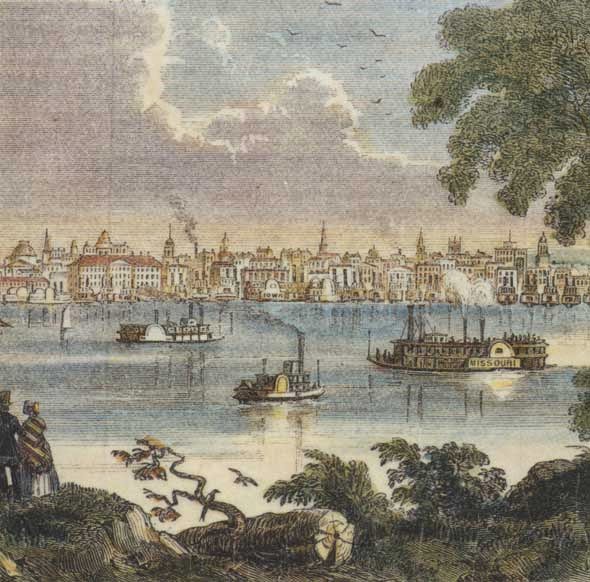
“Weather very cold. River remained frozen over for two
months. Most of the passengers were
taken to the meeting house where many died, others were scattered. Many went to the coal fields.
“I and Brother Follett remained together
that winter.
“I will say we both with our families were
treated well by many not in the church, particularly by one John Mageo, an
Irish Catholic who kept a store.
“In the spring we got work on the steamboat
at our business as ship carpenters in the employ of Captain James Eadis and
Nelson, known as The Submarine Diving Company.
There were four of our ship writes emmigrated [sic] together and all
apprentices together in the same port and all now were employed by the same company.
“Brother Follett was taken sick in the fall
and died the next spring. I was also
taken sick in the summer but God spared my life.
“We were member of the St. Louis stake of
Zion. I made the acquaintance of
President Erastus Snow, Mily Andrus, James Hart, Eldredge, George A. Smith,
Parley P. Pratt and hundreds of other good saints. Samuel Gray and William Algood left for
Florence.
“On October 7th 1856 I was ordained a High
Priest under the hands of George A. Smith and Erastus Snow and made a member of
the High Council.
________________________________________________________________
More of the story is available on the
FamilySearch website in an extract from the Latter-Day Saint Biographical
Encyclopedia:
His house was always
open to the missionaries, and among the many “Valley” Elders who shared in his
hospitality was Apostle Parley P. Pratt, who stayed at his home about a month
immediately before going to Arkansas, where he was murdered.
In June, 1857, Elder
Pollard continued his journey Zion-ward, joined the emigration at Florence,
Nebraska, and crossed the plains in Capt. Jacob Hoffines' company. Several
stampedes occurred on the plains; in one of these 46 head of cattle were lost.
On one occasion the cattle stampeded when hitched to the wagons. During the
affair Elder Pollard and wife, together with a number of others, were severely
hurt, being run over by several wagons. Through administrations and prayer
Elder Pollard was healed in a most miraculous manner, and the following day was
able to get around again. The company arrived in the Valley Sept. 22, 1857,
having camped several times in close proximity to the baggage trains belonging
to Johnston's army.
Elder Pollard located
in the fifteenth Ward, Salt Lake City, where he resided till the time of his
death. He found employment as a carpenter for Pres. Brigham Young, continuing
in his employ until 1869, when he commenced work for the Utah Central railway
company. Shortly after his arrival in the Valley, he was chosen as a Ward
teacher, and in 1861 was appointed to act as second counselor to Bishop Andrew
Cunningham. He subsequently served as a second counselor to Bishop Robert T.
Burton, whom he finally succeeded as Bishop of the Ward June 27, 1877. In 1862
he yielded obedience to the principle of plural marriage by marrying Ruth
Allen, who died about twenty years afterwards. Bishop Pollard died in Salt Lake
City, Feb. 21, 1890. He was the father of seven children, and was universally known
as a humble, upright man and a faithful Latter-day Saint.
Wednesday, September 3, 2014
Balance in our lives and an emphasis on enjoying our children
As many of you know, I have been compiling reunion yearbooks for our BYU Law School graduates. Last year, I completed 600 profiles from the 35th, 30th, 25th and 20th classes (1978, 1983, 1988 and 1993). This year, I have done the same for the same four class reunions (1979, 1984, 1989 and 1994). I am often very impressed with their careers, family and service noted in their profiles. I also make a list of their notable achievements in the community and in the LDS Church. Their personal statements are often inspiring like this one I am including in today's blog post. Here is a wonderful personal statement that I hope each of us is aspiring to accomplish in our lives. It is from an attorney in Florida from the BYU Law School class of 1989:
"With great relief after completing what I believed to be the most stressful years of my life in my efforts trying to juggle my law school studies with my responsibilities to my wife and two young daughters, I learned that I must have balance in all things. During the past 25 years as an attorney I have applied what I learned and made sure that I put family first. As a husband and father I have never missed any of my children's school activities, family outings, dinners with family, helping with household chores, assisting with children’s homework, dating my wife every Friday night, spending Saturdays with my wife and children, and serving in the Church. I have spent most of my days during the past 25 years creating memories with my family. My career has been only the means to this end. I have interviewed many young job applicants where I have asked them the hypothetical whether they would remain late at work to finish a project rather than attend their child’s school activity. Of those I hired I always told them that they would never be fired if they attended their child’s school activities, but they would be fired if they didn’t. To me, nothing has been more important than family. As a grandfather what I have learned most is that in the past I spent too much time trying to raise perfect children. I should have spent much more time just enjoying them. This is what I now do with my grandchildren – just enjoy them."
Monday, September 1, 2014
My Retirement Begins; Start of Daily Sharing from Dad/Opa
Lynn and I are enjoying a beautiful, Labor Day weekend at Zermatt, the first stay we have had here since June. Before that, we had our wonderful month with family in July and our retirement cruise on the Baltic and our visit with Jonny, Natalie, Deanne, Michael and Isaac discovering their beautiful new Moscow home and school during August.
Take a look at a couple of fun pictures I posted on Facebook today from the Cummings parkway (a rough, dirt road reached by driving all the way up Snake Creek Canyon alongside the Mountain course of the Wasatch Mountain State Park) and following it all the way over the top and coming out on the Deer Creek reservoir side by Cascade Springs. I highly recommend the drive.
As you know, I write in my journal almost every day. At the end of each entry, I include a scripture that I have marked that has been meaningful to me. I want to share them with you. I understand that some will speak to you too; some will not.
2 Nephi 31:
9 And again, it showeth unto the children of men the straitness of the path, and the narrowness of the gate, by which they should enter, he having set the example before them.
10 And he said unto the children of men: Follow thou me. Wherefore, my beloved brethren, can we follow Jesus save we shall be willing to keep the commandments of the Father?
Subscribe to:
Posts (Atom)
2014-07-24